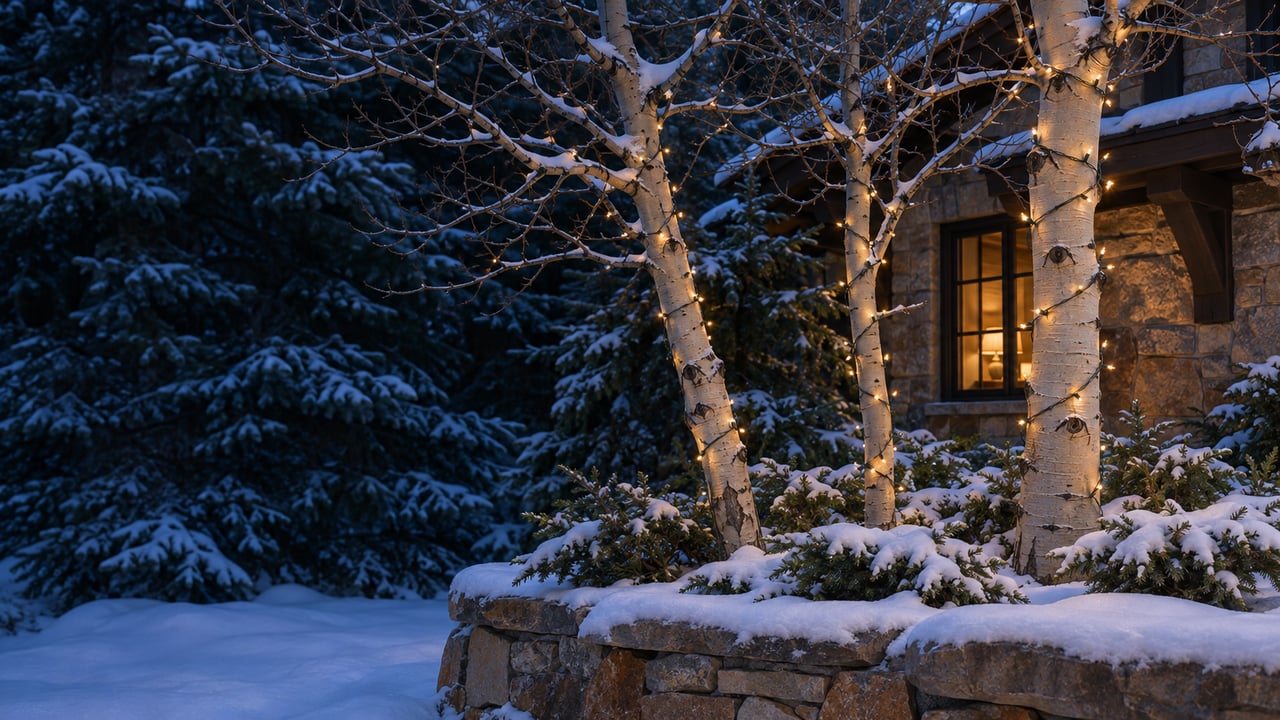
In April, a household in the Ski Ranches wrote to Mountain Village Town Council about tree lighting on a ridgeline property above the valley that seemed to run on a dusk-to-dawn timer all year. According to the letter, now part of the July 16 council packet, the lights could be seen across a wide area and stayed on all night.
Another letter in the same council packet made the same point more broadly. A full-time resident wrote that "Holiday lighting in trees is light pollution with many lights turned on every night year round even when the owners are not present."
Those letters explain the main point of the outdoor lighting ordinance Council adopted on July 16, 2026. Holiday strings are still allowed, under a generous brightness limit, and the ordinance's tightest seasonal rules govern dates and hours. Decorative lights now have a season and a bedtime, and this is the first winter both apply.
A Season With Start and End Dates
Under the ordinance amending Section 17.5.12 of the Community Development Code, seasonal lighting in residential areas is allowed from November 1 through January 31. It is prohibited from February 1 through October 31. By Thursday the window will have been open for nearly two weeks.
Council added one exception during the drafting. Holiday lighting outside the season may go up for up to 14 days, and it has to follow the same seasonal rules, including the nightly shutoff. The town's announcement says this covers "any holiday."
| Period | Residential seasonal lights | Nightly hours |
|---|---|---|
| November 1 to January 31 | Allowed | Off from 10 p.m. to 6 a.m. |
| February 1 to October 31 | Prohibited | Not applicable |
| Any holiday outside the season | Allowed for up to 14 days | Off from 10 p.m. to 6 a.m. |
The table is aimed squarely at the problem in those letters. Lights wrapped around a spruce in July or left on in an empty house through mud season now break the rules on the date alone, whatever their brightness.
The 10 p.m. Shutoff Is the Rule Most Likely to Catch Someone
The curfew got earlier while the ordinance was being drafted. The first draft set the overnight shutoff at 11 p.m. In the version revised for the April 23 meeting, Council moved it to 10 p.m.
That hour makes a difference even for owners who already use timers. One couple who wrote in support of the ordinance said their lights, on small fir trees at the top of their drive, were set to shut off at 10:30 p.m. That was early under the 11 p.m. draft. Under the adopted rule it is half an hour late.
The town's own advice is simple. Its October announcement "strongly recommends using an automatic timer for easy compliance." For a second home where nobody is around to unplug anything at 10 p.m., a timer is the only practical way to comply. A property manager setting up holiday lights for an absent owner now has the same deadline to work to.
Community Development Director Amy Ward framed it this way in the Town of Mountain Village announcement:
"As you get ready to decorate for the holidays, please take a few minutes to review the new seasonal rules. We all love to experience some festive holiday lighting, but many residents and our local wildlife will appreciate dark skies in the later evening hours."
What the Strings Themselves May Do
Within the season and before 10 p.m., the rules on the lights themselves are fairly loose. The ordinance allows the following:
- Color: white and colored lights are both permitted.
- Output: individual lamps must stay under 70 lumens per linear foot of lighting.
- Placement: strings may go in trees and along eaves, window trim, columns and railings.
- Coverage: lights may not fill or cover a home's walls or roof.
- Motion: moving and blinking lights are prohibited.
- Neighbors: if the Town decides a display detrimentally affects adjacent neighbors, it may declare the lighting a nuisance and require its removal.
Some rules apply all year and have nothing to do with the season. Landscape uplighting, floodlights and fixtures that produce glare are prohibited in every month. The ordinance also bars luminaires placed under trees or in planters to light the canopy. So the dramatic look of a spruce lit from below is not a holiday option, while a string of lights wound through its branches is.
Why the Village Center Stays Lit
The curfew and the blackout months do not apply to public areas in the Village Center or to lighting the Town installs. The April revision clarified that the Village Center's exemption from the blackout dates covers only public areas.
That exemption is what keeps the core's holiday calendar working. Holiday Prelude is scheduled for December 12 and 13, 2026. TMVOA describes the annual event as a collaboration among TMVOA, the Town, the Madeline Hotel & Residences, Telluride Ski & Golf Company and local merchants. Last year's Prelude included a 6 p.m. tree-lighting ceremony in Heritage Plaza with Santa and carolers. Last year's late-December programming also included light-mapping shows on the Madeline at Heritage Plaza. Those were the 2025 events.
On December 31, Visit Telluride's listing puts the New Year's Eve torchlight parade at 6:30 p.m., with Telluride Ski and Snowboard School instructors coming down the mountain, fireworks shortly afterward and the best viewing in the Mountain Village core.
So the ordinance gives the town two different patterns after dark. The core keeps its shared, scheduled lighting into the evening. The residential slopes around it, where the complaints came from, now go dark at 10.
Your Permanent Fixtures Are on a Much Longer Clock
The seasonal rules take effect this winter. The rest of the ordinance gives owners years. According to the Town, most existing fixtures can stay in place. These include fully recessed soffit, under-deck and under-roof lighting with bulbs rated at 2,700 kelvin or lower, and wall sconces at 850 lumens or less.
The fixtures most likely to need changes are pathway and stairway lighting and architectural lighting. The ordinance sets these dates:
| Trigger | What must comply | Deadline |
|---|---|---|
| Lighting not required by building code | Replace, retrofit or remove | Before January 1, 2031 |
| Lighting required by building code | Replace or retrofit | Before January 1, 2036 |
| Remodel or redevelopment valued at $500,000 or more, roof replacements excepted | All existing exterior lighting | With the project |
| Replacing 25% or more of a property's exterior lights | All existing exterior lighting | With the project |
Council may grant a variance for hardship, including the cost of replacing or retrofitting fixtures or a good-faith inability to comply. The Town's outdoor lighting regulations page also warns that fixtures marketed as "DarkSky Approved" do not necessarily meet Mountain Village's code. Anyone buying new fixtures should check them against the code itself.
The rules took a long time to write. Staff held Design Review Board work sessions starting in March 2025. Council first considered the ordinance on February 19, 2026, and then pushed second reading back through May and June so the Town and TMVOA could do more public outreach before the July vote.
Where the Darker Evenings Lead
The holiday curfew is one part of a broader push to keep the valley's night sky dark. Ridgway and Norwood are already certified DarkSky Communities, Ridgway since 2020 and Norwood since 2019. San Miguel County is applying to become a Dark Sky Reserve. In its October 2026 department updates, Mountain Village staff said they support the county's application and plan to bring a letter of support to Council before the end of the year.
This post is general information about a municipal ordinance, not legal advice. Owners should confirm how the rules apply to their own property with the Town's planning staff at [email protected] or with their own counsel.
If you own a home in Mountain Village and want to know how the new lighting rules, the 2031 and 2036 deadlines or the remodel triggers might affect your plans, O'Neill Stetina Group can go over it with you carefully and in confidence. Schedule a Private Consultation.